Back To Blogs
Latest Advice
x2025 Salary Benchmarks: The Technical Roles Redefining Compensation Growth
By Prime Talent Soluitons
7 min read
Dec 5, 2025

Tech hiring has become more selective, but salaries have not slowed.
In 2025, compensation is climbing fastest in the roles that directly accelerate AI adoption, reduce operational costs, and strengthen enterprise resilience. Even amid disciplined headcount planning, organizations are paying a premium for skills that unlock automation and productivity at scale.
Based on analysis of 65,000+ validated technical profiles, a new compensation pattern has emerged: salary growth is now skill-driven, not title-driven.
Where value creation is highest, compensation is rising the fastest.
Below is a breakdown of the technical roles that are setting the pace for compensation growth and the strategic implications for HR leaders navigating this next phase of workforce transformation.
Executive Summary for HR & Talent Leaders
Three dynamics now shape salary acceleration in tech:
AI capability is the dominant salary multiplier.
AI engineering, model deployment, data maturity, and MLOps expertise now influence both pay and organizational impact.
Efficiency roles have become profit levers, not engineering overhead.
Cloud optimization, DevOps automation, FinOps, and platform engineering now sit at the intersection of cost governance and performance.
Senior technical talent remains structurally scarce.
Hiring volumes have slowed, but the top 10% of candidates still command intensified competition across industries.
This new landscape demands a shift toward skill-based compensation frameworks, real-time benchmarking, and transparent mobility pathways; an approach increasingly adopted by leading HR and talent organizations.
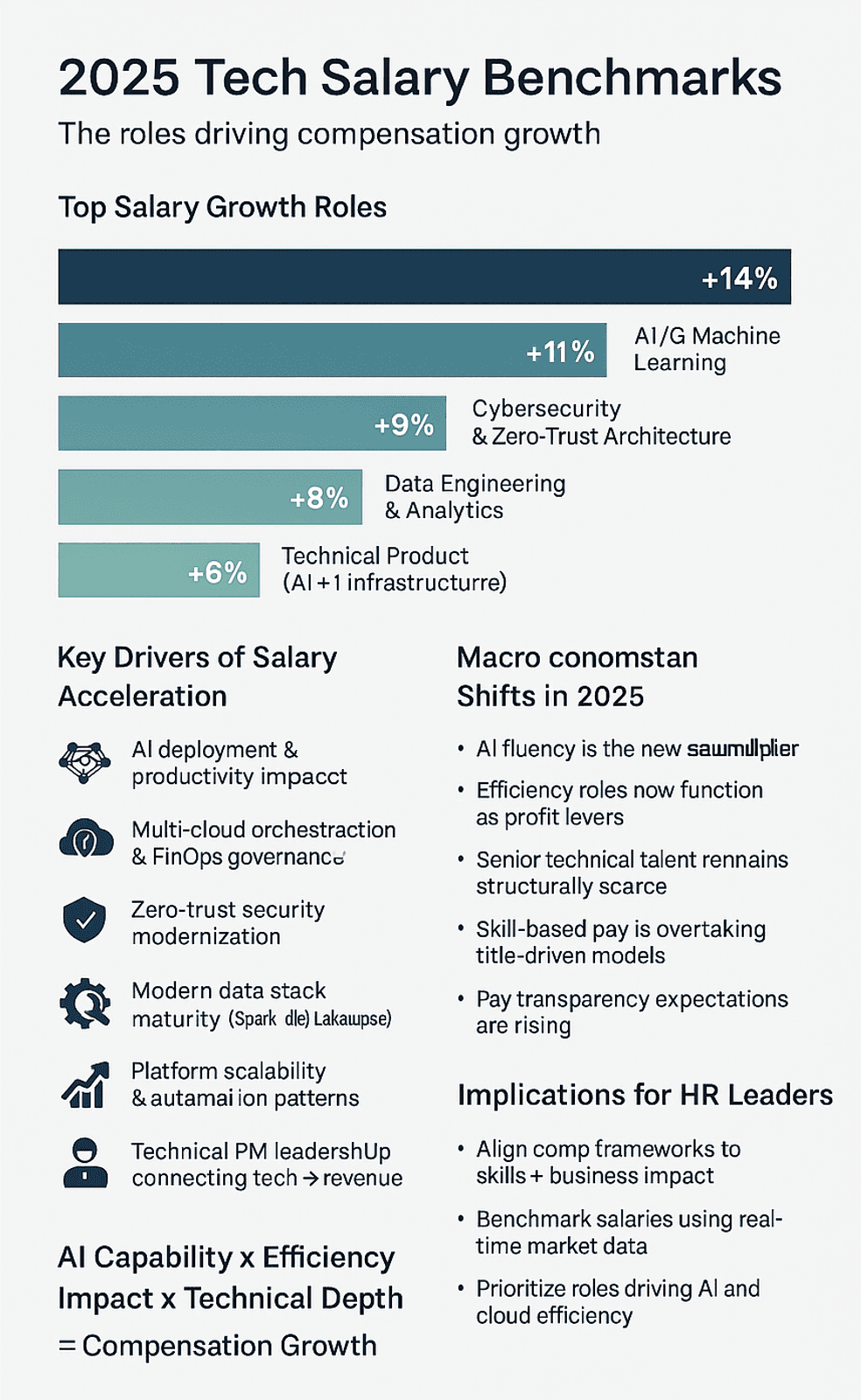
1. AI & Machine Learning Engineering - +14% YoY (Fastest Growth)
No discipline is reshaping compensation more than AI engineering. These roles now sit at the center of digital strategy and measurable business outcomes.
Roles driving growth
Machine Learning Engineer
LLM Systems Engineer
Applied Scientist
Model Optimization Specialist
Why compensation is rising
Expertise in transformer architectures, RAG pipelines, and multi-node training
Ability to build, tune, and deploy models into production environments
MLOps proficiency (Ray, MLflow, Kubeflow) to scale AI reliably
Demonstrated revenue or cost-impact outcomes
HR insight
Senior AI engineers have shifted from “research contributors” to direct revenue enablers, fundamentally altering compensation expectations.
2. Cloud, DevOps & Platform Engineering - +11% YoY
Cloud efficiency has become a board-level mandate. Organizations are now willing to pay a premium for roles that stabilize infrastructure, reduce spend, and accelerate delivery velocity.
Roles in demand
Site Reliability Engineer (SRE)
Cloud Infrastructure Engineer
Platform Engineer
FinOps/Automation Lead
Drivers of salary growth
Multi-cloud orchestration and cost governance
Infrastructure-as-Code excellence
Automation-first operating models
Ability to architect resilient, scalable platforms
HR insight
These roles function as EBIT protectors, a shift that places them on the critical path of operational strategy
3. Cybersecurity & Zero-Trust Architecture - +9% YoY
Security compensation continues to outpace general tech salary growth as regulatory pressure, digital exposure, and AI-driven threats intensify.
Roles leading demand
Security Engineer
IAM Architect
Threat Detection / SOC Automation Specialist
Application Security Lead
Drivers of salary growth
Enterprise-wide Zero Trust implementations
Increased emphasis on cloud posture management
Red/Blue team talent shortages
Automation-led detection and response capabilities
HR insight
Security roles are now viewed as risk mitigation investments, not cost centers, structurally supporting ongoing salary acceleration.
4. Data Engineering & Modern Analytics - +8% YoY
AI strategies succeed or fail based on data maturity. As organizations shift from experimentation to scaled deployment, data engineering has become a force-multiplier role.
Roles in demand
Data Engineer
Analytics Engineer
Lakehouse Architect
Data Platform Engineer
Drivers of salary growth
Proficiency in Spark, dbt, Kafka, Delta/Lakehouse patterns
Ability to design scalable, governable data models
Clear impact on decision velocity and model performance
HR insight
Data engineering has transitioned from a “technical backbone” to an AI enablement function, redefining compensation structures.
5. Technical Product Roles (AI + Infrastructure) - +6% YoY
AI strategies succeed or fail based on data maturity. As organizations shift from experimentation to scaled deployment, data engineering has become a force-multiplier role.Product leaders with genuine technical depth are increasingly rare and increasingly essential.
Roles in demand
AI Product Manager
Platform PM
MLOps PM
Data Platform PM
Drivers of salary growth
Ability to translate complex AI capabilities into commercial outcomes
Strong data literacy and systems understanding
Leadership across cross-functional engineering, design, and GTM
Ownership of cost, performance, and adoption metrics
HR insight
Technical PMs have become the bridge between capability and value creation, a dynamic that is reshaping compensation benchmarks.
Macro Trends Redefining Compensation in 2025
AI fluency is becoming a universal salary multiplier.
Across engineering, product, data, and infrastructure, AI capability now influences pay more than years of experience.
Efficiency is the new engineering currency.
Cloud optimization, observability, automation, and platform maturity have become top corporate priorities.
Senior technical talent remains scarce.
Even with reduced hiring volume, competition for top engineers and architects has intensified.
Skill-based compensation is overtaking title-based frameworks.
Competency mapping, adjacency models, and internal mobility pathways are accelerating organizational redesign.
Pay transparency expectations are rising.
Modern candidates expect real-time, validated datapoints, not ranges or self-reported averages.
Implications for HR Leaders and Tech Professionals
Salary direction is now skill-driven, not title-driven. For HR, TA, and business leaders, this creates several strategic imperatives:
Implement skills-based benchmarking to understand how specific capabilities influence compensation.
Assess salary variance by skill, level, geography, and domain to ensure competitive positioning.
Build internal career pathways aligned to high-growth skill areas such as AI engineering, data maturity, automation, and security.
Equip employees and managers with clear, evidence-backed compensation guidance to improve trust and retention.
Strengthen workforce planning with real-time market insights rather than historical averages.
This is the new foundation of workforce planning in technology.
Visual: The infographic provides a concise, data-driven visual summary of the technical roles experiencing the fastest salary growth in 2025.